“No space for just in case!”
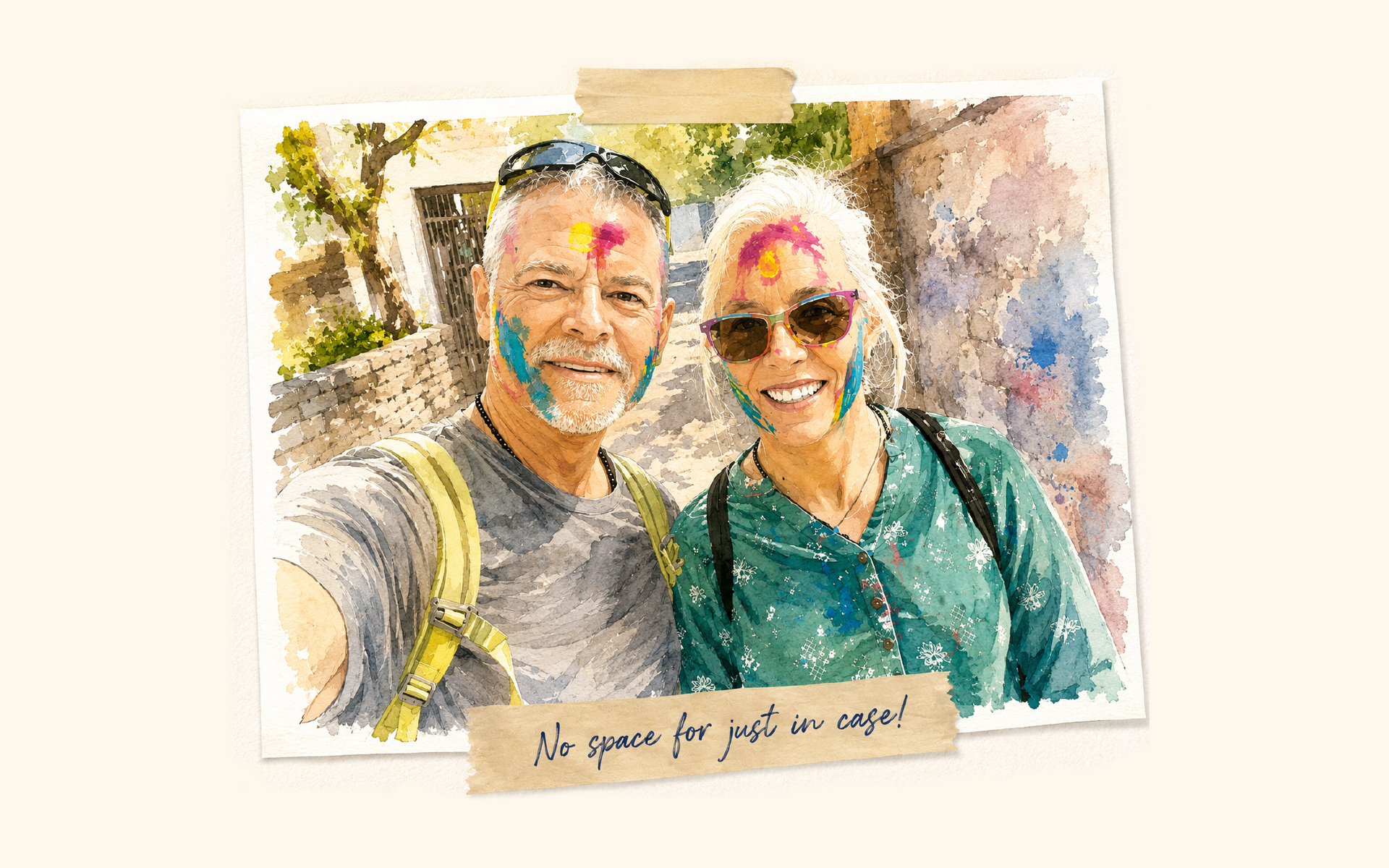
What we learned from packing our lives into two suitcases and working our way around the world.
We were watching a movie set in snow-covered Chicago when the question came up.
“Wouldn’t it be amazing to live there for a month?”
We were in our early 50s and thought we had our lives sorted.
We were partners in a communication business, and had been married long enough to know that a “what if..?” from Gavin Moffat was not a passing thought.
This one felt weightier and wilder, more alive than the default life we had adopted.
By the time we had finished talking, it had grown into: what if we started a nomad work life, slow-travelling the world and running our business from wherever we happened to be?
Our financial advisor, a good and careful man, suggested that we might want to think about our nest egg rather than our passport stamps. We understood and appreciated the advice, and then largely ignored it.
On April 27, 2022 — Freedom Day — we handed over the keys to our home of 19 years, donated 90 per cent of everything we owned, and stepped into the world with one 23-kilogram suitcase each.
Both of us were more afraid than we let on, and our fears were entirely different. Gavin’s was about control. He likes to know exactly where things are and how they work.
The prospect of living in other people’s spaces, in unfamiliar cities, was uncomfortable and a little terrifying.
My fear took longer to admit. I was afraid that six months in, I would turn to Gavin and say “I can’t do this.”
I loved our home in Johannesburg. I adored our garden. I especially adored our four hadedas, all of whom had names and had learnt to follow me to the back door for food.
The prospect of leaving felt less like the start of an adventure and more like loss. We went ahead anyway.
It’s been more than four years, and we still haven’t made it to snow-covered Chicago. We chose instead to ease into the radical with places we knew and loved.
Kenya first, then Mauritius, before pushing into the unfamiliar. We discovered early that slow travel was the only kind worth doing.
We would stay wherever we landed, for a minimum of six weeks, long enough for the tourist veneer to peel away and the real place to reveal itself.
Being communication professionals —strategic consulting, content creation, coaching and facilitation — made the transition to remote work easier than we had imagined.
Most of our clients are South African, which keeps us accountable across time zones and has shaped where we travel. The non-negotiables include reliable internet and a working day that doesn’t begin at midnight.
Online coaching and training sessions turned out to be more effective than expected. We look for co-working spaces nearby, or rent apartments with two separate rooms.
The harder discipline is resisting the pull of the place itself. When the street outside is abuzz with life, sitting at a laptop on the edge of deadline requires a wilfulness that doesn’t feature in the digital nomad brochure.
We had a mantra that kept us going. “No Space for Just in Case”. We had written it on masking tape and stuck it to our bathroom mirror as we dismantled our home.
It was a lot more than a guide to the way we packed our suitcases. It became our answer to every moment of hesitation.
We applied it to time, resisting the allure of just-in-case activities that didn’t earn a place in our schedule.
We applied it to relationships, making room only for the connections that really mattered.
We applied it whenever we found something beautiful in a market, knowing there wouldn’t be space for it in the case.
But there is always space for connections and experiences along the way.
In a coffee shop in Malindi, Kenya, Gavin enjoyed a conversation with the Italian owner, who shared the history of the coastline and the story of interwoven cultures.
History leaves its residue on people in ways that only reveal themselves when you slow down enough to listen.
In Amritsar, India, we built a connection with our Tuk-Tuk driver, who invited us to celebrate Holi with his family.
In their home, with their rituals, colours and laughter, I understood the difference between passing through a place and being welcomed into it.
It is the difference between looking at a painting through a window and being allowed to step inside it.
In New Delhi, we were denied entry to Hauz Khas, a 13th century stone fortress, on the grounds that it was “open to Indians only”.
A family who saw us being turned away took up our cause with considerable indignation. When that still didn’t open the gate, they invited us to tea.
We spent the afternoon with four aunts, four daughters, an assortment of nephews and nieces, and the warm company of a multigenerational household sharing one building.
They accompanied us to the fortress the next day, when a guard they knew was on duty. The gate opened and we wandered in.
We went on to enjoy regular walks and talks through the grounds. Our friendship is now in its fourth year.
Gavin and I are back in Johannesburg now, living in different parts of Gauteng to stay close to family for a busy season of milestone celebrations. It turns out that even a city we think we know has more to offer when we stop returning only to its familiar corners.
What we have learned, in the meantime, is that life is more generous than our what-ifs will allow us to believe. We are more adaptable than our fears will ever let us know.
When we finally stopped making space for just in case, the most awesome things had room to arrive. What we don’t carry, defines where we can go.
Related stories



The Change Programme
Are you thinking about making a change? Or trying to make a change? Or dealing with some change that’s happened? Whether you’re getting married or having a baby, moving house or jobs, starting a diet or stopping smoking… the Change Programme is for you.
Start the programme now!