The things I have in common with Maggie, Maya, and the Empress of China
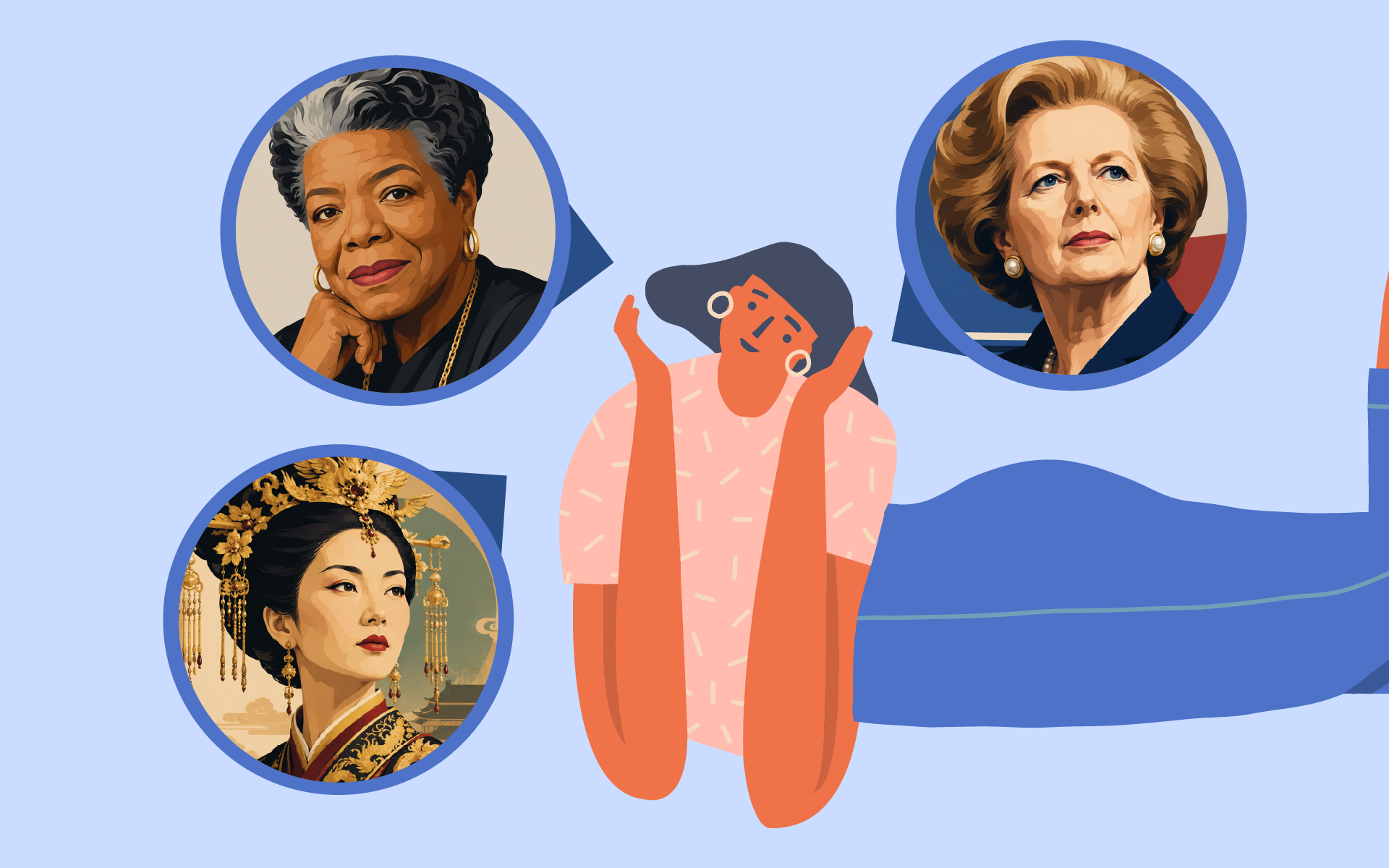
History shows us that women don’t need to be likeable to succeed.
I remember being told by a male friend, just before an important interview: Just be yourself. What foolish advice I thought. Be myself? Who exactly is that?
Baby Boomer women like me, (I was born in 1958, after World War 2) have a host of personas; ways to be, depending on who we’re with and what role we’re playing at the time: obedient, deferential, jolly, confident, reticent, loving and caring.
But in interviews, I’m mostly anxious, uncertain with a severe dose of imposter syndrome.
Words like “I’m not good enough. I’m going to be found out at any minute and be shamed in public” still ring in my ear and cause me distress and alarm. Silly words, actually. The truth of it is that I am extremely competent.
I’ve edited a Coastal paper and been responsible for not only the gathering and publishing of news but dealing with the complicated lives of a staff of more than 25 demanding men and women.
Like the majority of girls in my era, I have never wanted to rock the boat. I just wanted to be liked.
I wanted to be admired and respected without a fuss, to meld into the crowd without being spotlit. At the same time, I wanted a voice, to be heard, to make my mark – quietly.
But that meant opening myself up to criticism, to being labelled “difficult”, for choosing to swim upstream. A tricky choice.
My mother thought that vociferously standing up for yourself was “unladylike”.
It’s the lesson that “unlikeable” women through history learnt early. To succeed in a world where you are competing with the “Masters of the Universe” you have to defy the trope, and literally be your true, authentic self, with a loud voice that clearly articulates your needs.
Think Margaret Thatcher, Britain’s first female Prime Minister. Born into the Silent Generation in 1925, she was notoriously vocal and often, accurately in her case, called “unlikeable”.
The Tough Lady label was wielded to criticise her strong and uncompromising leadership. Was she “nice”?
Everybody who’s ever known or written about her says she was not. Was she effective?
Yes, even though by introducing radical free-market reforms and ruthlessly crushing militant trade unions she caused mass unemployment, killed off small mining towns and widened the gap between the haves and have nots. It earned her deep and lasting hatred, but she was resolute, unbowed in her single-mindedness.
Equally revolutionary was Coco Chanel, the fashion designer who changed how women dressed.
Born into the Lost Generation in 1883, she refused to yield to social pressures. “I don’t care what you think about me,” she once said. “I don’t think about you at all!”
Add to the list US Supreme Court judge Ruth Bader Ginsburg; poet and civil rights activist Maya Angelou; Empress Wu Zetian, the only woman in Chinese history to assume the title of Emperor; and Catherine the Great, who ruled the Russian Empire for 34 years.
Then there’s my favourite strong African woman, Nobel peace prize winning Kenyan social, environmental and political activist Wangari Maathai.
She founded the Green Belt Movement that focused on planting trees, on environmental conservation and women’s rights.
These women, and there are tens of thousands more like them, didn’t care if they were labelled “unlikeable”.
They refused to pay heed to the punishment meted out to non-conforming women. Or if they did, they did not let it show.
I was not so brave. And yet I was. In the words of Samuel Beckett in The Unnamable, my motto was: I can’t go on. I’ll go on.
In 2006 I was appointed as editor of The Weekend Post, in Port Elizabeth, now Gqeberha. I had a substantial staff of reporters, sports writers, sub editors, a sales team and the people who oversaw the printing of the paper.
While we were a fairly cohesive team, people looked to me to make the big decisions. And looking back on it, I was afraid all the time.
By making one decision, I always put someone else’s nose out of joint. I had to say no to those who asked for leave, or pay increases, or a different shift. I had to cancel columnists because my budget was cut, or censure people who’d stepped out of line.
I hated knowing that some people didn’t like me, that they talked about me behind my back. It stressed me out. It depressed me.
In the same breath, I would not have given up the position easily. I liked being in charge, even though my every nerve took strain.
I learnt, in those torturous years, to back myself and to find a way through.
In Alcoholic Anonymous (I’m a recovering alcoholic with 20 years of sobriety under my belt, something I consider my greatest achievement) they say, “fake it till you can make it”.
And that is what I did. I busked my way through the job, adequately it would seem, as I was allowed to keep on doing it.
The how I did it became clear much later when I learned that through empowering the women in the team, by giving them more responsibility, they helped me share the burden.
I was not alone. I was backed by people, mostly women I trusted implicitly, who had my back just as I had theirs.
It’s a really important lesson to learn, one I’m sorry I didn’t learn sooner.
Contrary to the assertion that women tear other women down instead of helping them climb the corporate ladder, or succeed in the workplace, I have found astonishing support and understanding – even kindness – from women.
As a boss, I ensured the women on my team had a voice, backed up with authority, and watched as they moved into their competent selves.
Which brings me to the encouraging findings among Generation X and Generation Alpha young women.
I admit that this new generation of girls and women surprises, confuses and scares me a little, so different are they in their thinking and behaviour.
They today talk openly about subjects that were socially hidden in my day, issues deemed taboo. Talking about them would have made my mother, and me, cringe.
Now, it’s all on the table for discussion: menstruation, plastic surgery, miscarriage, sexuality, divorce, women’s reproductive health, LGBTQ+ rights.
This shift is the result of the breaking of taboos by “unlikeable” women, like Malala Yousafzai, the Pakistani Nobel Prize winner who was shot for going to school, and who’s since made it her life’s work to advocate for girl’s education.
The downside is that research shows that Millennials, Gen X, Gen Alpha and Gen Beta suffer disproportionately, when compared to Baby Boomers like me, from mental health issues.
Is this because, in removing the stigma attached to experiencing problems of the mind, we’ve opened up the floor for discussion?
Or are young people suffering the pandemic aftermath of isolation, exacerbated by social media habits which make them more isolated, and therefore lonelier?
Whatever the cause, women, unlikeable or not, are now seen as more than just cardboard-cutout figures. It is acknowledged that they have problems with mental health, and that they are happy to be complex, chaotic, messy.
Equally as important, women in 2026 won’t be talked down to, or at. They’re not always “nice” and they don’t seem to care. We’ve come a long way, baby!
Related stories


The Change Programme
Are you thinking about making a change? Or trying to make a change? Or dealing with some change that’s happened? Whether you’re getting married or having a baby, moving house or jobs, starting a diet or stopping smoking… the Change Programme is for you.
Start the programme now!