What my mom taught me about facing fear and starting over
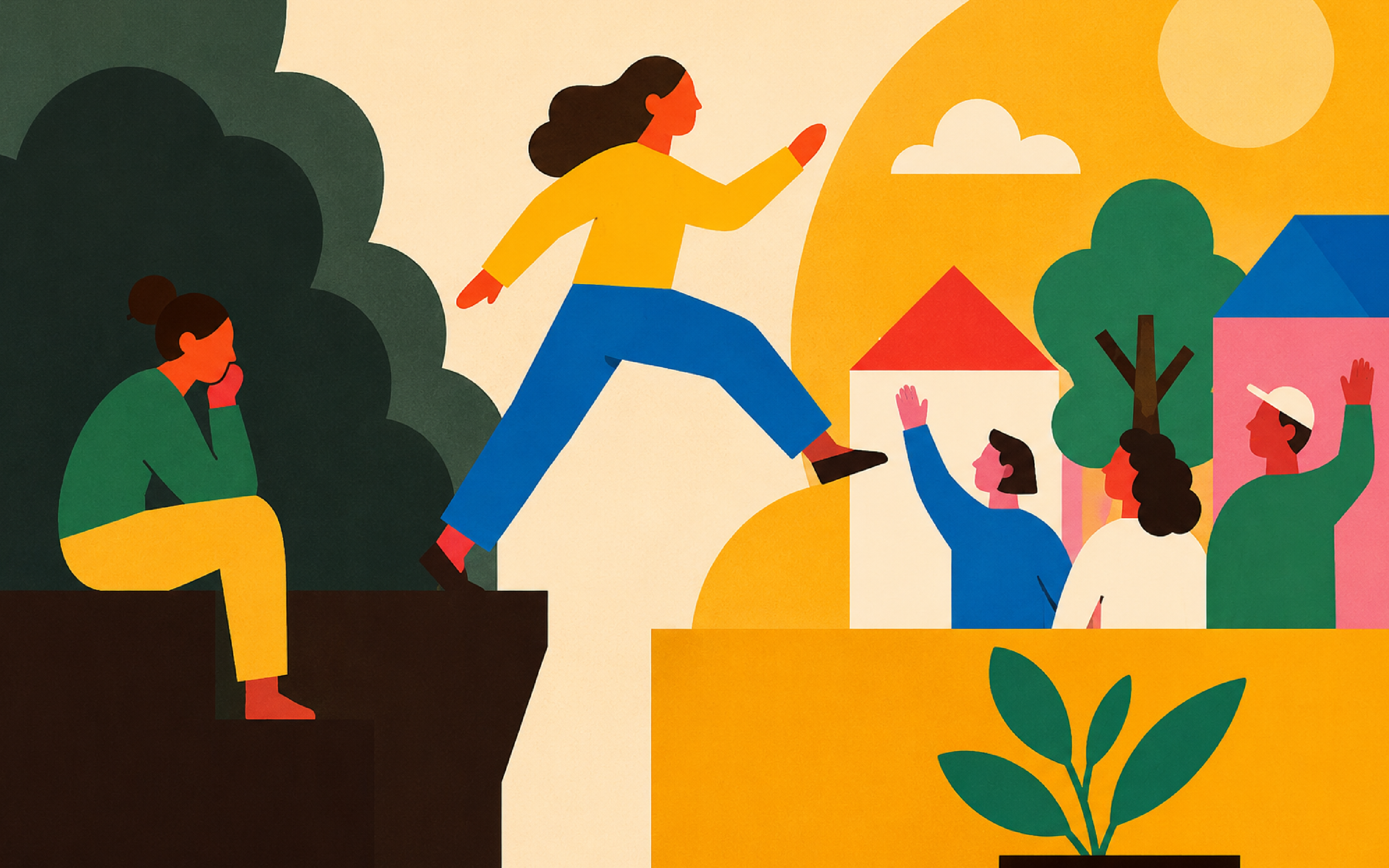
Sometimes we just have to take the leap in life that scares us most.
There is a kind of fear that doesn’t arrive as panic, but as common sense. It sounds a bit like this: “Maybe next year”, or “things aren’t that bad”, or “let’s just wait and see how the next few months go”
It’s often dressed in the language of prudence, responsibility, or good timing, and it is extraordinarily convincing. I know, because I listened to it for a long time.
I recently went through one of the biggest changes of my life, and for a long time I stood at the edge of it, without moving. That sense of being immobilised wasn’t because I didn’t know what needed to happen.
Fear had made itself comfortable, in the shape of reasonable questions. What would happen? Would I regret it? Would life ever feel settled again?
Watching myself hesitate made me realise something else. Fear is good at telling us what we might lose. It is much less forthcoming about what we might gain.
My mother reminded me of that. Even in her late 70s, when most people are settling deeper into routine rather than dismantling it, she has not stopped embracing change.
This month, she gave up the home she had lived in for 20 years to move closer to me and my son in Johannesburg. It wasn’t her first big change in recent years.
She had already downsized from the family home into something smaller in a retirement village in KwaZulu-Natal. After months of preparing and renovating her new place in Johannesburg, she did it all again.
What struck me most wasn’t the move itself. It was the people on either side of it. Her friends in KwaZulu-Natal gave her a proper send-off: a farewell tea where her late boyfriend’s son picked up a guitar and played a song for her.
Friends I had never met messaged me afterwards, not to mourn that she was leaving, but to say how pleased they were that she would be closer to family.
On the other side of that leap, a new community appeared before she had even unpacked. Curious neighbours wandered over during the renovations to introduce themselves. A welcome tea was organised in her first week.
While I was wrestling her new computer into talking to her printer, a couple from across the road arrived unexpectedly with a potted plant and their good wishes.
Watching all of this unfold made me realise how incomplete fear’s story really is. It warns us about everything we stand to lose, but says almost nothing about the people, opportunities and unexpected kindness waiting on the other side.
Fear has a remarkable talent for making uncertainty feel more dangerous than unhappiness. Psychologists call this “loss aversion”, the finding by Daniel Kahneman and Amos Tversky that we experience the pain of loss far more intensely than the pleasure of equivalent gain.
In other words, we are neurologically wired to hold on, even when letting go might serve us considerably better. It’s useful information, if you can hear it over the noise of all those reasonable questions.
Psychologist William Bridges, who spent decades writing about life transitions, argued that all real change begins not with a new beginning but with an ending, and that endings involve a loss that must be properly mourned before anything new can take root.
I found that oddly comforting. The mistake most of us make, is waiting to feel ready. Courage is not the absence of fear. It’s moving while fear is sitting right there beside you.
It’s the first difficult conversation, the signed document, the first night alone, the first family celebration that looks different. None of those things feel possible from the edge. They only become possible by doing them.
It’s a bit like standing beside a cold swimming pool after winter. Your mind runs an efficient inventory of reasons not to jump. Then you put in your toes, then your feet and ankles, and somehow, you’re swimming. It turns out the fear lived mostly in the anticipation.
Life’s biggest transitions often work the same way. The first step creates momentum. The second creates something that starts to feel, tentatively, like confidence.
What surprised me most, in my own experience and in watching my mother begin again, was that neither of us did it alone.
I had assumed, in the way we often do, that I would need to be strong, that facing this would require some private reservoir of resilience I’d somehow have to discover.
What I found instead was the generosity of friendship. People checked in on me. They listened without agenda. They reminded me who I was when I had temporarily misplaced the information.
My mother’s experience reflected the same truth. One community lovingly let her go, while another gathered around her almost immediately. Different people, different places, but the same generosity.
Even mutual friends showed up with a kindness I hadn’t anticipated. The psychologist Martin Seligman describes resilience not as a fixed personal trait but as something fundamentally relational, built and sustained through our connections with others. I felt that this year in ways I never had before.
We tend to imagine facing big change as a solitary act. We are David and the change is Goliath. But most of us, if we turn around, find an army – our village, really – standing behind us. They’ve been there all along, waiting to be called upon.
So, if you’re standing at the edge of something today – a relationship, a career, a city, or a version of yourself that no longer fits – it’s worth asking what you’re actually protecting.
What future are you preventing by staying where you are? And what are you saying no to because you’re afraid to say yes to what you really need?
Frank Herbert wrote in Dune that fear is the mind-killer. I’d add that it’s also a talented procrastinator. Action is the antidote. Not grand, all-at-once action, just the next small step. Then the one after that. They might not feel like leaps, but they add up over time. And the water, I promise, is not as cold as you think it is.
Related stories


The Change Programme
Are you thinking about making a change? Or trying to make a change? Or dealing with some change that’s happened? Whether you’re getting married or having a baby, moving house or jobs, starting a diet or stopping smoking… the Change Programme is for you.
Start the programme now!